

What Frank Made Possible
On legacy, liberation, and finishing what he started

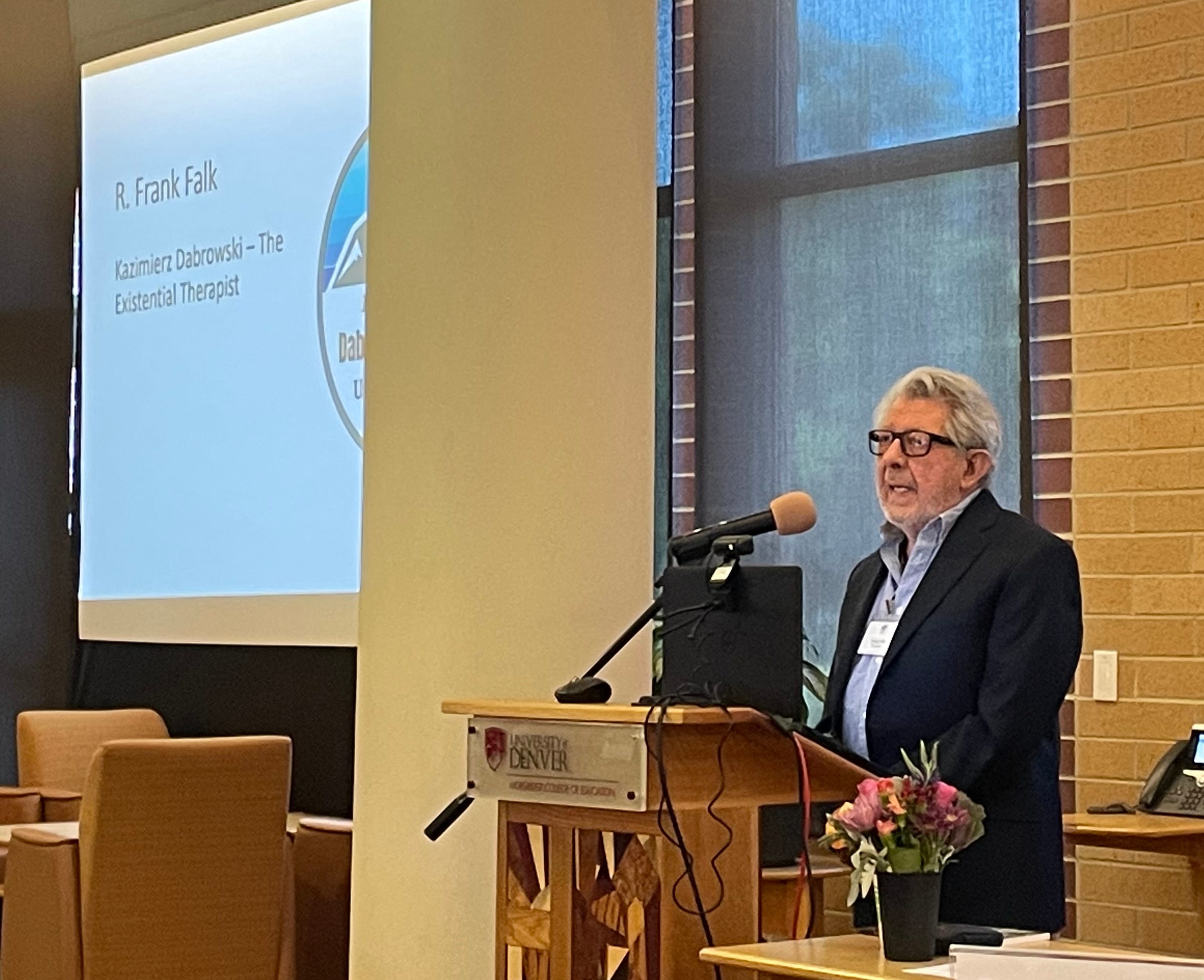
Three years ago today, we lost Frank Falk.1
He had been my mentor, collaborator, and friend for six years by then. He was the Director of Research at the Institute for the Study of Advanced Development and a co-developer of the Overexcitability Questionnaire-Two (OEQ-II), the instrument most widely used to measure overexcitability in the research literature.
In the last years of his life, he was the person I could bring my hardest questions to—about the theory, the field, and what it was costing me to remain inside a system that had drifted so far from the theory it claimed to serve.
Frank’s last wish was for me to finish his paper as co-author. It was the keynote he had delivered at the 2022 Dąbrowski Congress in Denver, titled Kazimierz Dąbrowski: The Existential Therapist. He had a draft, notes, and the copious archive of our work together, but he ran out of time.
That paper came out last year in Advanced Development. I want to say something here about Frank, and what our years together looked like from where I sat.
The shift
When I met Frank in 2015, he had spent decades doing rigorous empirical work on overexcitability. He described that focus in our April 9, 2019 interview:
“One of the things that intellectually I’ve done for a long time—almost all my career—I’ve taken on the measurement of difficult concepts, or new concepts, and tried to figure out how to get some way of empirically looking at them. That’s sort of a talent that I have, and it’s a skill that I have.”
He co-created the OEQ-II, OIP-II, and OEQ-IIc, and knew the instruments inside and out.
What he had yet to encounter was the rest of the early Polish record in Dąbrowski’s work: the 1935 textbook on nervousness in children, the 1938 paper, “Types of Increased Psychic Excitability,” and the 1949 paper on “Disintegration as a Positive Stage in the Development of the Individual.”2 In 2019, I was bringing him this material, and I watched him read it for the first time.
When we began exploring together what Dąbrowski had actually documented, something shifted in him. He told me once that the 1949 paper was the most informative piece by Dąbrowski he had read. He was revising his own understanding in real time, in the last years of his seventies and into his eighties, after a career of work on this theory.
During our interview, I watched him arrive at conclusions he had been circling for years. Asked about the reach and limitations of the OEQ-II, he was direct:
“Except for intellectual overexcitability, there’s no consistent finding with regard to giftedness and overexcitability.”
He added: “If we wanted to try to make it into a diagnostic tool, I don’t know what we’d do.” And then he named what he saw:
“The critical areas that I now see as so much more important are imaginational and emotional [OEs]. And trying to capture just those, alone, I think would be extremely difficult. Because of the breadth of it all.”
That is the co-developer of the OEQ-II saying that the construct is larger than what his instrument could capture.
He went further at our NAGC session in November 2021, the last conference presentation we gave together. During the virtual component we recorded, he told gifted educators, “Overexcitability is a medical neurological term. It is not a personality concept.”
He showed data from the ISAD database demonstrating that “the only overexcitability that continually shows up with regard to gifted is intellectual overexcitability.” He said plainly:
“You can’t even say that as people become more intelligent, as measured in IQ, that they become more overexcitable. It’s simply not true.”
And then came the line that I still recall so clearly:
“This is the kind of thing where those of us that create empirical data keep wondering what it is we need to do to get people to stop saying things which don’t fit with the data themselves.”
That was Frank at NAGC, saying publicly what his decades of measurement had shown him.
What we found together
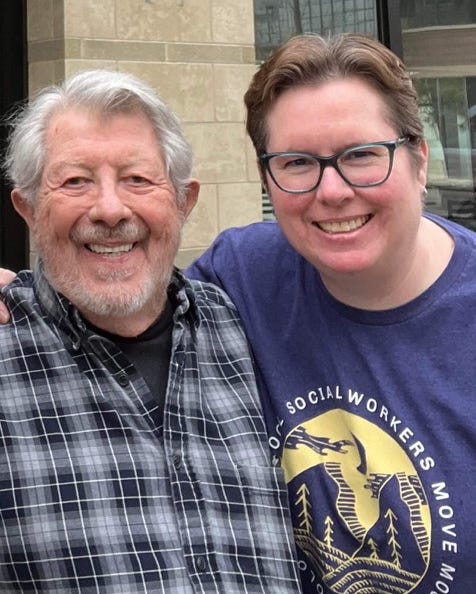
The mentorship transformed both of us. In June 2018, while preparing to present together at the Dąbrowski Congress on “Overexcitabilities: The Drivers of Developmental Potential,” I wrote in my journal:
“Frank said that it is only now, doing this work with me, that he has felt like he understands the theory and it makes sense.”
A man who had studied Dąbrowski's constructs for decades was saying, in a room full of his closest colleagues, that our collaboration had changed what the theory meant to him. He was closing in on eighty. I was in my mid-forties and had defended my dissertation two weeks before. What passed between us did not move in one direction.
Our 2021 paper, “The Origins and Conceptual Evolution of Overexcitability,” came out of this work. It was the first systematic English-language account of where overexcitability came from, what it was before it entered gifted education in 1979, and what happened when it arrived. Frank’s name on that paper was significant because he was the one who had measured OE for decades. His reassessment was the reassessment of the person who had helped build the measurement apparatus.
The collaboration also produced moments that illustrated what happens when lived experience meets measurement expertise. In our interview, I raised the connection between sensual overexcitability and addiction that I’d been writing about based on my own history. Frank responded immediately:
“Your notion about sensual [OE] and addiction was so right on. As soon as you said that to me, I could relate immediately to every drug I’ve ever had. It is sensual, and it’s got nothing to do with your mind or your imagination.”
That kind of exchange, where a concept becomes real because someone with the right experience names what the data alone can’t, is what our collaboration was built on.
When I asked him in the same interview what impact Michael M. Piechowski had on his life, his answer was characteristically dry: “He’s certainly thrown me down the garbage path of overexcitabilities.”
Michael later heard this line and assumed Frank meant "garden path," but Frank had meant exactly what he said.
After our NAGC 2021 session, Frank wrote to me: “I think we work well together and I even enjoy the opportunity.” That even was pure Frank—the understated acknowledgment that something in him had been reactivated.
The last visit
The last time I saw Frank was January 4, 2023, at a Panera in southwest Denver. His wife, Nancy Miller, came, too. Frank had a new electric VW Tiguan with a sunroof he wanted to show me, so he had me sit in the driver’s seat and look up.
The weeks leading up to that lunch had been difficult. A paper had come out in Advanced Development that I strongly disagreed with, and the conversations that followed were hard on everyone involved. Through all of it, Frank stayed in steady contact, sending texts and calling me.
In the middle of the worst of it, when I told him how the conflict was going, he wrote back: “You have a strong personal involvement in the theory that few truly possess.” When I told him I didn’t know how to respond to something that had been published, he offered to write a response paper with me as co-author. That was Frank: practical and willing to put his name on what he believed.
As our lunch wound down, Nancy headed out, but Frank stayed, and we kept talking. I told him about the book I was trying to write—that I had gone on a deliberate search for a mentor years earlier, and that I now needed his guidance in shaping what the book would become. Frank had helpful things to say about it, and as we prepared to say goodbye, he told me he was proud of me. I had no idea that afternoon that it would be the last time we saw each other.
Within two weeks, Frank had sent a $500 donation to the Dąbrowski Center. He was also taking over as host of the Dąbrowski Study Group, which I had been hosting with my account for nearly two years and was stepping back from. When he got locked out of Zoom before the next meeting, I hosted from my account so everyone could get in. It was the last thing we did together as a working pair.
The inheritance
Frank had spent decades building instruments to measure overexcitability. In the end, he concluded that they were not adequate for what the theory actually required—that the construct was too broad, and too deep, to be captured by any questionnaire he or anyone else had yet devised.
He also came to see something more fundamental. The theory belongs to the people Dąbrowski actually studied—the ones who live with relentless anxiety and depression and obsessive inner worlds, the ones psychiatry diagnoses and schools pathologize. Frank gave me the permission to say that plainly and the trust to carry the work of returning it to them.
Every paper I publish now is shaped by what he taught me, and by his willingness to revise his own position in public when new evidence demanded it.
Three years gone, and the collaboration continues.
Thank you, Frank. I am still listening for what you would say next.
Frank was our guest on Positive Disintegration Episode 5: Researching Overexcitability.
References for the three titles I mentioned:
Dąbrowski, K. (1935). Nerwowość dzieci i młodzieży [Nervousness of children and youth] (1st ed.). Nasza Księgarnia.
Dąbrowski, K. (1938/2019). Types of increased psychic excitability (Michael M. Piechowski, Trans.). Advanced Development, 17, 1-26. (Original work published 1938)
Dąbrowski, K. (1949). Dezintegracja jako pozytywny etap w rozwoju jednostki [Disintegration as a positive stage in the development of the individual]. Zdrowie Psychiczne, 3–4, 26–63.
Oh Chris, this brought tears to my eyes! Thank you for letting us witness the significance of the mentorship relationship you and Frank shared through this beautifully written article. I have personally learned so much from you as you continue this important work! 💛